
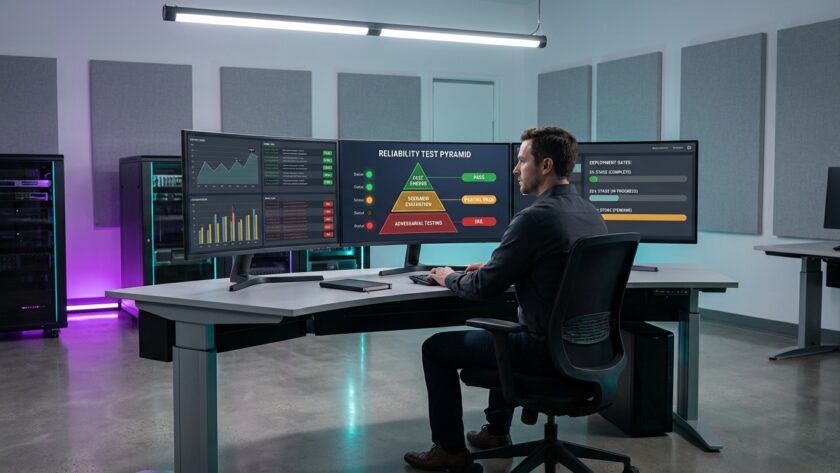
AI reasoning reliability is not a model selection problem. It is an operating model problem. This post provides a practical test framework covering layered reliability testing, contract-based prompt design, human-in-the-loop escalation, and phased rollout discipline for teams moving AI from pilot to production.
AI reasoning reliability is not a model selection problem. It is an operating model problem. If your team cannot define what reliable means for your specific workflow, measure it before release, and monitor it after release, the system is not production ready, regardless of benchmark scores.
The most expensive AI failure is rarely a dramatic public outage. It is the quiet erosion of trust that happens when a system is correct often enough to be used, but wrong often enough to be risky. Teams keep shipping because the demo looked strong, users keep trying because the first few responses looked smart, and then adoption stalls because no one can predict when the system will drift from helpful to hazardous.
That pattern has been impossible to ignore. According to a 2024 Stanford HAI report, fewer than 10% of organizations that piloted large language models successfully moved them into sustained production. Industry coverage continues to highlight concerns about reasoning quality, questions about benchmark reliability, and platform moves toward monetization and broader deployment. None of those stories say AI is failing. They do show that capability growth is outpacing operational discipline.
Here is the approach I use with teams that want to move from impressive pilots to dependable production systems.
Why Doesn’t Benchmark Performance Predict Production Reliability?
Most organizations still start in the same place: model leaderboard results, benchmark summaries, and vendor launch claims. Those signals are useful for procurement conversations, but they are weak predictors of how your system will perform in your environment.
Why? Because benchmark tasks are clean. Real work is not. Your users write vague prompts, mix multiple objectives into one request, leave out critical context, and ask for exceptions that no benchmark includes. Your internal data is messy, your process constraints are real, and your risk tolerance is domain specific.
A model can score high on abstract reasoning and still fail your business in very practical ways:
- It gives plausible but incomplete answers when data is missing.
- It is directionally correct, but misses one critical compliance step.
- It handles routine cases well, but collapses on edge cases your team sees every day.
- It overstates confidence when uncertainty should trigger escalation.
Production reliability starts when you stop asking, “How smart is the model?” and start asking, “How predictable is this system inside our workflow?”
Build a Reliability Test Pyramid
Teams that ship reliably use a layered testing strategy. Not a single score, not a one time UAT run, and not ad hoc spot checks after launch. A reliability test pyramid gives you coverage across speed, realism, and risk.
Layer 1, Fast Deterministic Checks
These are your CI speed tests. You are validating schema compliance, required fields, policy constraints, and obvious formatting violations. This layer should run on every change, and should fail fast.
If your AI output must include a risk level, a recommended next action, and citation fields, this layer enforces it. Do not treat structure as cosmetic. Structured output is the contract that keeps downstream systems stable.
Layer 2, Scenario Based Evaluation
This is where reliability starts to become real. Build a curated set of representative tasks that reflect your actual user traffic. Include easy cases, moderate ambiguity, and cases that commonly break today.
Score each scenario against criteria that matter to your business, not generic benchmark categories. Typical dimensions include factual grounding, procedural correctness, completeness, and confidence calibration. Keep this dataset versioned, and add to it every time production reveals a new failure mode.
Layer 3, Adversarial and Stress Testing
This layer tests behavior under pressure. Prompts with conflicting instructions, incomplete context, data that should trigger refusal, and long multi step interactions that expose memory drift. The goal is not to prove your system is invincible. The goal is to know how it fails, where it fails, and whether those failures are containable.
When teams skip this layer, they are usually surprised in production by issues they could have found in one afternoon of deliberate red teaming.
Move from Prompt Tuning to Contract Design
Prompt tuning matters, but it is not enough. Reliability improves faster when teams treat AI behavior as a contract between three components: the prompt, the tools, and the output schema.
In practice, that means you define:
- What the model is allowed to do.
- What external tools it can call, and under which conditions.
- What a valid answer must include before it is accepted.
- What uncertainty signals force fallback or escalation.
This design choice buys you two things. First, safer execution because the model has clear boundaries. Second, better observability because failures become classifiable. Instead of “AI did something weird,” you can say, “tool routing failed,” “evidence was insufficient,” or “output contract was violated.”
That diagnostic clarity is what lets teams improve quickly. Without it, every incident looks unique, and every fix is a one off patch.
Add Human Judgment at Decision Boundaries
Many teams frame human review as a temporary crutch. That is the wrong framing. Human judgment is a design component, especially where decisions have financial, legal, or reputational impact. Research from MIT Sloan found that human in the loop systems outperform fully automated ones by 30% on decision accuracy in high stakes contexts, precisely because humans catch the edge cases models normalize.
The key is selective intervention, not blanket approval queues. You want explicit escalation triggers:
- Low confidence on high impact recommendations.
- Missing evidence for required claims.
- Conflicting tool outputs.
- Policy sensitive language patterns.
When escalation is rule based, reviewers focus on real risk instead of rechecking everything. This preserves speed while preventing silent failure propagation. It also creates labeled data you can use to improve the system over time.
In client programs, this is where trust usually turns. Stakeholders stop seeing AI as an unpredictable assistant and start seeing it as a controlled capability with clear guardrails.
How Should Teams Phase a Risky AI Rollout?
A reliability mindset changes deployment behavior. You do not release a new reasoning stack to all users at once because tests passed in staging. You phase it, measure it, and widen exposure only after observed performance clears your thresholds.
A practical rollout sequence looks like this:
- Internal canary with expert users.
- Small external cohort in low risk workflows.
- Expanded audience with active telemetry and kill switch.
- Full release after reliability metrics stabilize.
Define your stop conditions in advance. If grounding failures exceed a threshold, if escalation volume spikes, or if user corrections trend up week over week, pause rollout. This sounds obvious, but many teams only define success criteria and forget to define retreat criteria.
If you need a planning scaffold for this rollout discipline, our methodology can be adapted directly into AI release gates.
Create a Reliability Operating Rhythm
Reliability is not a launch milestone. It is an operating cadence. The teams that stay ahead of failure drift run the same loop every week:
- Review incident clusters by failure class.
- Update the scenario dataset with new edge cases.
- Track pass rates by workflow, not by aggregate average.
- Prioritize fixes by user impact and business risk.
- Re run evaluation before every major prompt, model, or tool change.
This rhythm turns reliability from a subjective argument into a measurable discipline. Product leaders can see where confidence is rising, where it is degrading, and where investment should go next.
It also improves cross functional alignment. Engineering, product, operations, and compliance stop debating anecdotes and start working from the same evidence.
The Bottom Line
AI systems do not become reliable by accident, and they do not stay reliable on their own. The organizations getting real value are the ones treating reliability as a first class product capability: tested, instrumented, phased, and continuously improved.
If your team is still evaluating AI primarily through demos and leaderboards, you are missing the layer that determines production outcomes. Shift the question from “Which model is best?” to “Which operating model keeps this system dependable under real workload conditions?” That is where long term advantage lives. If you are mapping that shift now, this is exactly the kind of AI strategy work we do with leadership teams in the field.
Need to harden an AI workflow before broader rollout? Let's talk.
For a deeper look at how AI agents create new governance challenges, read why agentic AI is just over-permissioned.
Related Posts

Why AI Pilots Matter Before Full Rollout
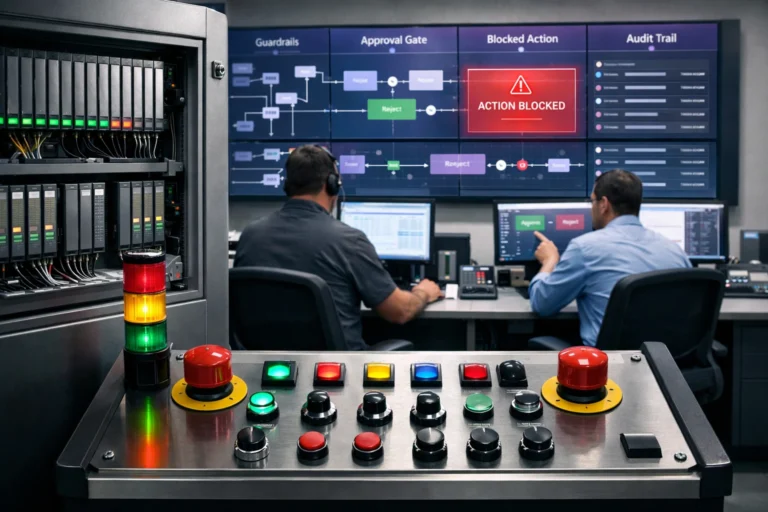
Your Agentic AI Is Not Evil, It Is Just Over-Permissioned