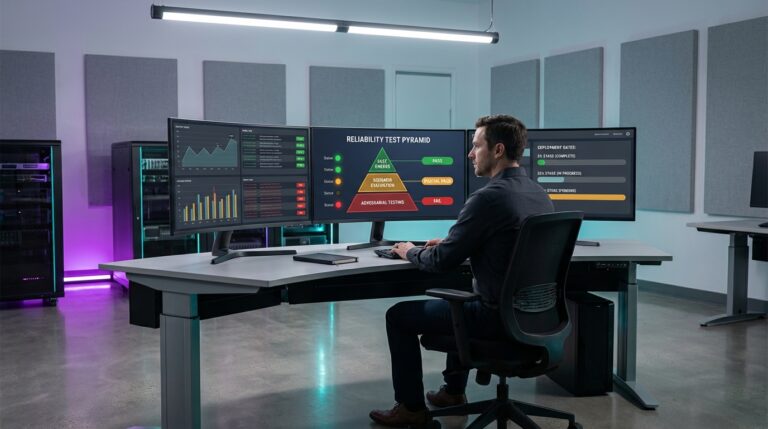

Building a habit tracker revealed that architectural decisions like offline-first syncing and graceful failure handling are fundamentally product decisions, not just technical ones. Reliability and user trust form the foundation that every feature depends on, and choices about state management and error recovery directly shape whether users feel confident in the app. Product leaders who understand these technical tradeoffs can collaborate more effectively with engineering and avoid building features on unstable foundations.
I thought building a habit tracker would be simple. Track a few habits, show streaks, maybe send a reminder. The concept is well documented. How hard could it be?
Turns out, building real software, even a personal project, forces you to confront the same tradeoffs that define great product strategy. Not the theoretical kind you read about in frameworks. The kind that keep you staring at your screen at 11 PM, weighing two imperfect options and knowing that “both” isn’t one of them.
What Is the Naive Product Assumption?
When I started building WisdomPulse, a habit-tracking app designed around daily reflection. I had a clear mental model. Users would log habits, see progress, and build momentum over time. Simple input, simple output.
What I didn’t anticipate was how quickly “simple” features reveal architectural decisions that ripple across the entire product. Every choice about how data flows, how state is managed, and how failures are handled becomes a product decision, not just a technical one.
This is what separates product managers who can collaborate deeply with engineering from those who treat the backlog as a wish list.
Three Product Decision Points That Changed Everything
1. State Management: The Trust Equation
The first major decision was how to manage state. Should habit completions sync immediately to a server, or should the app work offline-first and sync later?
A non-technical PM might ask: “Can’t we just save it?” A technical PM anticipates: “What happens when a user marks a habit complete on their phone, loses connectivity, and opens the app on another device?”
I chose an offline-first approach with eventual consistency. The user sees immediate feedback: their streak updates instantly. But the system reconciles conflicts in the background. This decision traded implementation simplicity for user trust. People abandon habit trackers when they feel unreliable. A one-second delay in showing a completed habit creates doubt: Did it save?
The product lesson: reliability isn’t a feature. It’s the foundation that every other feature depends on. You can’t iterate your way out of a trust deficit.
2. Async Failures: Streak Anxiety
Streaks are powerful motivators, until they break unfairly. The second architectural decision involved how to handle asynchronous failures. What happens when a sync operation fails silently? Does the user lose their 47-day streak because of a network timeout?
A non-technical PM might spec: “Show an error message.” A technical PM asks: “What’s the blast radius of this failure? Does it affect only this habit, or does it cascade to the user’s entire motivation system?”
I implemented a grace period, a 24-hour reconciliation window where the system accepts late completions without breaking streaks. This wasn’t a technical necessity. It was a product decision rooted in understanding user psychology. The cost was additional complexity in the sync logic. The benefit was that users never experienced a “false break,” the kind of frustration that makes people delete an app and never come back.
The product lesson: error handling isn’t a technical detail. It’s a user experience decision that should be owned by the product team, not delegated to engineering defaults.
3. Data Model: Feature Velocity
The third decision was the most invisible and the most consequential. How should habits be modeled in the database? A flat structure (one row per habit per day) is simple to implement and query. A nested structure (habits grouped into categories with metadata) is more complex but dramatically more flexible.
A non-technical PM might not even know this decision exists. A technical PM recognizes that the data model determines which features are easy, which are hard, and which are impossible without a rewrite.
I chose the nested approach, and it paid off months later when I wanted to add reflection prompts tied to specific habit categories. With a flat model, that feature would have required a migration. With the nested model, it was an afternoon of work.
The product lesson: data architecture is product architecture. The decisions you make in week one determine your velocity in month six. PMs who understand this can have fundamentally different conversations with their engineering teams.
What Is the Translation Layer Between Code and Product?
Here’s what I’ve learned from building this, and from 15 years of working at the intersection of product and engineering: the value of a technically fluent PM isn’t that they can write code. It’s that they can translate between two worlds.
When an engineer says “we need to refactor the state management layer,” a non-technical PM hears delay. A technical PM hears: “Our current architecture is creating user-facing bugs that will compound over time, and fixing them now is cheaper than fixing them after launch.”
When a designer proposes a seamless multi-device experience, a non-technical PM says “great, add it to the backlog.” A technical PM says: “That requires an event-sourcing architecture we don’t currently have. Let’s scope what we can deliver in this cycle and plan the infrastructure work for the next one.”
This translation isn’t about gatekeeping or saying no. It’s about asking better questions earlier, before the sprint starts, before the commitment is made, before the team discovers the hard constraint in week three of a four-week cycle.
The Takeaway (for more on architectural foundations, see Scaling Before AI)
Building WisdomPulse taught me something I’d suspected but never experienced so directly: the best product decisions happen at the boundary between what’s possible and what’s valuable.
The value isn’t that I can code. It’s that I know the right questions to ask before asking engineering to build something. I know when a “simple” request will take a week and when a “complex” one is actually straightforward. I know when technical debt is acceptable and when it’s a time bomb.
In a world where AI is making every product decision more technical, this kind of fluency isn’t optional. It’s the difference between leading a product and managing a backlog.
Building resilient products requires deliberate architecture decisions. See how AI strategy consulting can guide yours.
Making product architecture decisions where resilience matters? Let us connect.
Related Posts

Why AI Pilots Matter Before Full Rollout
Your Agentic AI Is Not Evil, It Is Just Over-Permissioned