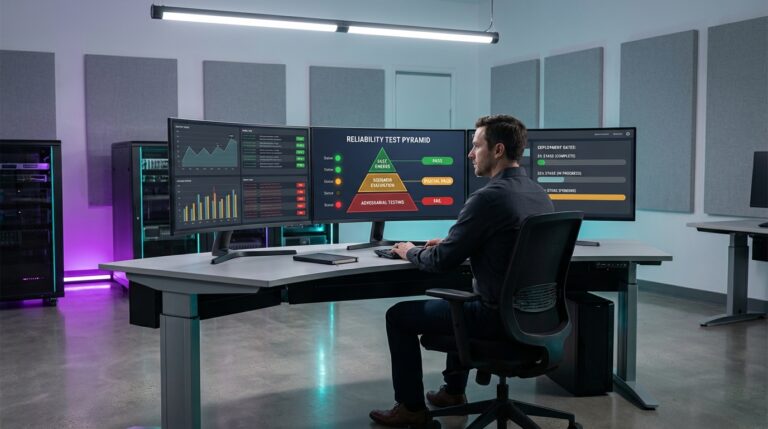

Model capability alone does not determine AI project success; organizations must assess five interdependent dimensions: strategic clarity, data readiness, technical capability, organizational alignment, and investment readiness. The weakest dimension becomes the bottleneck, so leaders should evaluate all five before funding to identify and address the primary constraint first. This targeted readiness assessment takes minutes but prevents costly stalls by revealing misalignment between teams before development begins.
Most AI initiatives that stall had a capable model. What they lacked was readiness: a defined outcome, usable data, a team that could build and run the system, a sponsor who owned the result, and a budget sized for the real timeline.
Readiness is not a single score. It is five separate conditions, and the weakest one sets the ceiling for everything else. A company with excellent data and no executive owner will stall just as surely as a company with an eager sponsor and data nobody trusts.
That is why I ask leaders to run an AI readiness assessment across all five before they fund a build. It takes less time than a vendor demo, and it tells you exactly what to fix first.
What Is AI Readiness?
AI readiness is an organization’s ability to turn a specific AI use case into a system that runs in production and delivers a measurable business result. It covers five dimensions: strategic clarity, data readiness, technical capability, organizational alignment, and investment readiness. An organization is ready when none of the five blocks the others.
Few organizations start there. Cisco’s AI Readiness Index, cited in a 2024 RAND study, found that only 14 percent of organizations reported being fully ready to integrate AI into their business, even as most leaders expected AI to reshape it.
Readiness is not the same as AI maturity. Maturity models grade how advanced an organization looks overall, and vendor checklists usually measure readiness to buy a particular product. Readiness is specific to one initiative: the same company can be ready for document classification and nowhere near ready for an autonomous agent in claims processing.
What Does an AI Readiness Assessment Measure?
An AI readiness assessment scores each of the five dimensions separately, identifies the weakest one, and turns the gaps into a short list of actions. A useful assessment takes minutes to answer, uses plain statements a leadership team can agree or disagree with, and produces next steps rather than a maturity badge.
The AI readiness assessment on this site asks ten questions, two per dimension, and returns a score with focused next steps. Its value lies less in the number than in the conversation it starts. When the CTO and the CFO answer the same ten statements differently, you have found the real gap before it found you.
Which Five Dimensions Decide Whether AI Ships?
Each dimension answers a different question about the same initiative. Here is what weak and ready look like in practice.
1. Strategic Clarity
Strategic clarity means leadership has defined the business outcome AI should change, and each priority use case maps to a measurable goal. When it is weak, the brief is “do something with AI,” and success is defined as a working demo. When it is ready, every use case fits in one sentence: which decision or process improves, by how much, and how you will measure it.
2. Data Readiness
Data readiness means the data a use case needs is accessible, reasonably clean, and owned by someone accountable for its quality. When it is weak, the data exists in principle but sits in systems nobody can extract from, and definitions differ from one team to the next. When it is ready, you can pull a representative sample this week, you know its gaps, and every critical dataset has a named owner.
3. Technical Capability
Technical capability means the team has practical experience shipping AI systems, and the environment supports iteration, deployment, and monitoring. When it is weak, the work lives in notebooks with no path to production and no way to evaluate output quality. When it is ready, someone on the team has deployed and maintained a model before, and there is a pipeline for evaluation and rollback.
4. Organizational Alignment
Organizational alignment means an executive sponsor owns delivery, and the teams whose work will change are prepared for it. When it is weak, sponsorship is enthusiasm without ownership, and operations hears about the new system at launch. When it is ready, one named executive owns the outcome, and the people who will use the system help evaluate it from the first weeks.
5. Investment Readiness
Investment readiness means there is committed budget for a pilot and for scaling, and leadership expects results on a realistic timeline. When it is weak, the budget covers a pilot and nothing after it, and leadership expects a return within a quarter. When it is ready, the pilot is funded, a decision point for scaling funds is on the calendar, and the timeline matches what a structured AI pilot can prove. This gap is common: practitioners interviewed for the RAND study reported that leaders often expect AI projects to take weeks instead of months.
Why Does the Weakest Dimension Set the Ceiling?
AI initiatives fail at their weakest dimension because the five depend on each other. Strong data cannot compensate for a missing owner, and a talented team cannot ship a use case nobody defined. Averaging the five scores hides exactly the gap that will stall the project.
The research points the same way. RAND’s 2024 study of AI project failures, based on interviews with 65 experienced practitioners, cites estimates that more than 80 percent of AI projects fail, about twice the rate of IT projects without AI. The two leading root causes it found were leaders misunderstanding the problem AI should solve and a lack of suitable data, followed by underinvestment in infrastructure. Those are readiness gaps, not model gaps.
The mismatches follow a few recognizable patterns:
- Strong data and no sponsor: the pilot works, then stalls in a prioritization meeting that nobody owns.
- A strong team and a vague outcome: engineers build an impressive system that solves a problem the business does not rank.
- A clear strategy and unready data: the roadmap is right, and the first months go to extraction and cleanup that nobody budgeted.
- An eager sponsor and an unrealistic timeline: the initiative is judged a failure at week six for missing a result planned for week twelve.
In every case, the fix is cheaper before the build than during it. That is the whole argument for assessing first.
How Should You Act on Your Readiness Score?
Act on the lowest dimension first. If any dimension is weak, close that gap before funding a build. If all five are workable, run a bounded pilot. If all five are strong and a pilot has proven the use case, plan the scale-up.
Fix first. A weak dimension calls for discovery, not development. Map the data, name the owners, and write the outcome statement before anyone writes code. That is the work of Find the Signal, the first step of an AI strategy engagement.
Pilot. When every dimension is workable, prove the use case with a fixed budget, a fixed timeline, and success criteria agreed in advance. A pilot turns a readiness score into evidence and ends with a clear go or no-go decision.
Scale. When a pilot has proven the use case, choose the next initiatives with the same discipline. Prioritizing ruthlessly keeps the second project from stalling on a gap the first one exposed.
Start With the Gap, Not the Model
The most expensive AI mistake I see is not choosing the wrong model. It is funding a build while one of the five dimensions quietly blocks it. A ten-question AI readiness assessment is enough to find that dimension, and finding it early costs far less than finding it in month four.
Take the free AI readiness assessment to see where you stand, or read how readiness fits into a full AI strategy engagement.
Weighing an AI investment and want a second opinion on your readiness? I can help.
Frequently asked questions
How long does an AI readiness assessment take?
The self-assessment on this site takes a few minutes: ten statements, two for each of the five dimensions. A facilitated assessment adds stakeholder interviews and a review of the actual data, which takes longer but produces a prioritized list of gaps with named owners.
Which AI readiness gap should you fix first?
Fix the lowest-scoring dimension first, because it sets the ceiling for the other four. When two dimensions tie, start with strategic clarity: without a defined outcome, you cannot tell which data, skills, or budget the initiative actually needs.
Is AI readiness the same as AI maturity?
No. AI maturity describes how advanced an organization's AI practice is overall. AI readiness is specific to one initiative and asks whether the conditions exist to ship it. A mature organization can still be unready for a new use case, and a less mature one can be ready for a narrow pilot.
Related Posts

Why AI Pilots Matter Before Full Rollout
Your Agentic AI Is Not Evil, It Is Just Over-Permissioned